
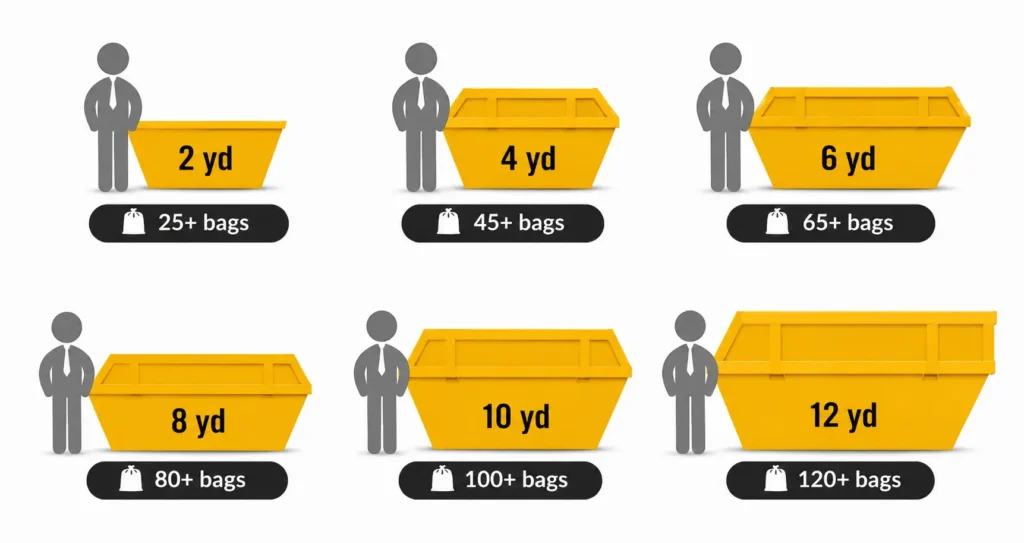
House clearances are rarely straightforward. Whether you are clearing a family home after a bereavement, emptying a property before a sale, or finally getting through decades of accumulated furniture and clutter, the volume of waste can catch people completely off guard. The most common and costly mistake people make is hiring a skip that is either too small — meaning they need a second collection — or too large, which means paying for space they never use.
Getting the size right from the start saves time, money and the frustration of a skip company turning up with a lorry you did not plan for.
Quick Answer: What Skip Size Do You Need?
For most standard house clearances in Essex, a 6-yard or 8-yard skip will be sufficient. If the property has been occupied for many years and contains bulky furniture, white goods, or significant garden waste, a 10 to 12 yard skip may be more appropriate. One-bedroom flats and partial clearances can often be handled with a 4-yard midi skip.
The table below gives a straightforward starting point:
Property Type | Recommended Skip Size |
One-bedroom flat or partial clearance | 4-yard midi skip |
Two to three-bedroom house | 6 to 8 yard skip |
A three- to four-bedroom house with a garden | 8 – 10 yard skip |
Large detached property or full clearance | 10 to 14 yard skip |
Commercial or estate clearance | 14+ yard roll-on roll-off skip |
These are guidelines rather than guarantees. What actually fills a skip is not the number of rooms, it is the density and bulk of what comes out of them.
Understanding Skip Sizes: What Do the Yards Actually Mean?
Skip sizes are measured in cubic yards, which is a unit of volume rather than weight. One cubic yard is roughly equivalent to the space taken up by a standard washing machine. So a 6-yard skip holds approximately six washing machines’ worth of material — though in practice, household waste is rarely packed that neatly.
A brief reference:
- 2-yard mini skip — suited to small garden clearances or a single room. Not practical for full house clearances.
- 4-yard midi skip—handles one to two rooms comfortably. Good for flat clearances or targeted declutters.
- 6-yard skip — the most commonly hired size for two-bedroom properties. Fits a reasonable volume of furniture, boxes, and general household waste.
- 8-yard skip — appropriate for larger homes or clearances that include outdoor items like sheds, fencing, or garden furniture.
- 10 to 12 yard skip—used for three- to four-bedroom houses where the clearance is thorough and bulky items are involved.
- 14 yards and above (RoRo)—required for large estate clearances, commercial sites, or where significant construction or renovation waste is also being removed alongside household items.
You can compare skip sizes and prices in detail if you want to cross-reference dimensions and tonnage limits before making a decision.
How to Estimate the Right Size Without Guessing
A practical method is to walk through each room and categorise what you are removing. The volume problem is usually not the small stuff — it is the items people underestimate, such as mattresses, sofas, wardrobes, and carpets.
Work through the property like this:
Go room by room and count the large items: beds, wardrobes, chest of drawers, sofas, dining tables and chairs, white goods. Each large furniture item typically takes up around half a cubic yard once broken down or placed at an angle. A double mattress on its own can take up 1.5 cubic yards of skip space if it cannot be compacted.
Once you have counted the furniture, factor in the bagged waste — bin bags of clothing, kitchenware, books, small appliances, and general clutter. A full bin bag is roughly 0.07 cubic yards. Forty bin bags account for approximately 3 cubic yards of space.
Then consider the garden and garage, which are often forgotten in initial estimates. A shed clearance, a pile of old fencing, or a stack of tyres (noting that tyres are often not accepted in skips — check with your provider) can add significant volume.
If you are still unsure, the safest approach is to size up rather than down. The cost difference between a 6-yard and 8 yard skip is usually modest. A second collection, on the other hand, adds the full cost of an additional skip and another delivery and collection fee.
What Can You Put in a House Clearance Skip?
Most standard household items are accepted in a skip, including furniture, carpets, general rubbish, garden waste, timber, and electricals such as televisions and washing machines (though some skip hire companies charge a small surcharge for these due to WEEE regulations).
However, certain materials are classed as hazardous waste and cannot be placed in a standard skip under any circumstances. The Environment Agency is clear on this — businesses and households have a duty of care to ensure waste is disposed of legally and appropriately. You can read the full guidance on the UK Government’s waste duty of care page.
Items that cannot go in a standard skip:
Asbestos, paint tins with liquid paint, plasterboard in large quantities (it must be kept separate due to the hydrogen sulphide gas it produces when mixed with other waste in landfill), tyres, gas canisters, batteries in large volumes, clinical waste, and any liquids, including oils and solvents.
If your clearance involves a property built before the 1980s, check for asbestos in floor tiles, roof panels, or pipe lagging before hiring a skip. Accidental inclusion of asbestos in a standard skip creates significant legal liability.
Does the Skip Need to Go on the Road?
This is a question that trips up a surprising number of people in Essex. If your skip will be placed on a private driveway or land, no permit is required. If it needs to sit on a public road — even partially — you will need a skip permit from the local authority.
In Essex, this typically means applying through your local council, whether that is Havering, Barking and Dagenham, or Redbridge. Most reputable skip hire companies will handle this application on your behalf, but it is worth confirming this before booking. You can check the official guidance on highway permits through GOV.UK.
Permit costs and processing times vary by borough. In some areas,s they can be arranged within 24 to 48 hours, but it is sensible not to leave this until the day before you need the skip delivered.
House Clearances Across Essex: Location Considerations
Essex covers a wide range of property types, from Victorian terraces to modern semi-detached estates and rural properties with substantial outbuildings. The size of the skip you need can be influenced not just by property size but by access and road conditions.
In areas like Romford and Ilford, terraced properties and busy residential streets mean road-placed skips are common, and permit applications are routine. If you are organising skip hire services in Romford or arranging skip hire in Ilford, factor in the permit process and discuss placement options with your provider when booking.
In more suburban areas, driveways are often large enough to accommodate a skip without requiring a permit. Household skip hire in Hornchurch and skip hire in Upminster frequently fall into this category, where a mid-range skip on a private drive is straightforward to arrange.
For properties closer to the Thames corridor, including Rainham and Dagenham, it is worth noting that skip hire in Rainham and skip hire in Dagenham sometimes involve additional considerations for commercial or mixed-use properties, particularly where clearances overlap with light trade or construction waste.
If you are based further east or dealing with a larger estate, skip hire in Chadwell Heath and waste disposal options in Barking are both available through the site for quick comparison.
Common Mistakes to Avoid
People consistently underestimate how much space furniture takes up. A three-piece suite, a dining table, and two wardrobes can fill a 66-yard skip before the loose items are even loaded.
If you are clearing a property that has been occupied for thirty or forty years, plan for the possibility of needing more space. Some clearances are better split across two smaller skips rather than one large one, depending on access.
Booking a skip for Monday delivery and only discovering a permit is needed on Friday afternoon is a common and avoidable problem. If there is any chance the skip will need to go on a public road, raise this at the point of booking.
Placing a tin of paint, a car battery, or a bag of plasterboard in an otherwise ordinary skip can result in the load being rejected at the waste facility. This creates delays and, in some cases, additional charges. Always check what is and is not accepted before loading.
Standard skip hire in Essex typically includes a hire period of 7 to 14 days. If a house clearance is being done over several weekends, clarify the hire period upfront to avoid collection before you have finished or extension charges at the end.
Conclusion
Choosing the right skip size for a house clearance is less about guesswork and more about being methodical before you book. Walk the property, count the bulky items, think about what is in the garage and garden, and size up if you are on the fence between two options. The cost difference is small. The inconvenience of running out of space is not.
If you are organising a clearance anywhere across Essex, getting a quote early and being specific about what the clearance involves will give you the most accurate recommendation. A good skip hire company will ask the right questions if you describe the property and what you are removing.
Frequently Asked Questions
The 6-yard skip is the most commonly hired size for house clearances in Essex. It suits two to three-bedroom properties where furniture, carpets, and general household waste are being removed. For larger homes or clearances that include garden or garage contents, an 8 to 10-yard skip is more appropriate.
Yes, in most cases, mattresses are accepted in standard skips, though some companies apply a small surcharge per mattress. This is because they are difficult to compact and take up significant space. If you have multiple mattresses, mention this when getting a quote.
Only if the skip is placed on a public road or pavement. Skips on private driveways do not require a permit. If you do need road placement, your skip hire company can usually apply for the permit on your behalf through the relevant local authority.
Hire periods vary by company, but 7 to 14 days is standard across most of Essex. If you need the skip longer — for example, if a clearance is being done in stages — speak to the company when booking. Extensions are usually available at a daily rate.
It depends on the volume of waste and how much labour is involved. Skip hire is generally more cost-effective when you are doing the loading yourself and have a significant volume of waste. Man-and-van services include labour, which adds to the cost but is useful when you cannot do the physical work yourself. For large house clearances with heavy furniture, some people use both — a clearance team to remove items and a skip for the remaining loose waste and rubbish.