
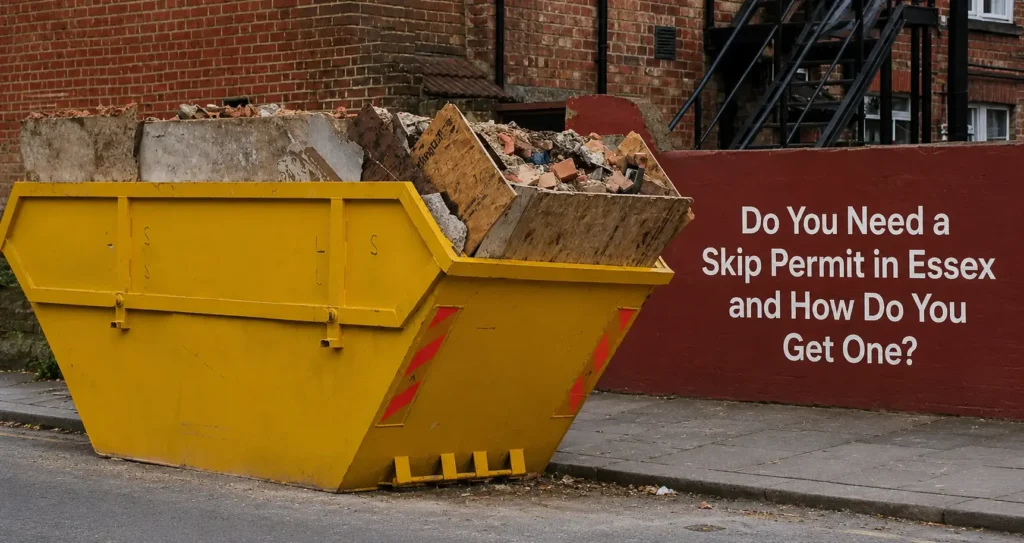
Quick Answer: When Do You Need a Permit?
No skip on your driveway or private land? No permit needed. Full stop. The moment any part of that skip sits on a public road, pavement, or verge, you need written permission from your local highway authority. That rule comes from Section 139 of the Highways Act 1980, which has been on the books for over four decades and is still enforced regularly. It does not matter if the skip is there for two days or two weeks. There is no minimum duration. One wheel over the curb line onto the pavement, and you are into permit territory.What Actually Counts as a Public Highway?
More than most people realize. The road itself, obviously. But also the pavement, the grass verge between the path and the road, and shared access roads that are maintained at public expense. A lot of homeowners in Essex have semi-detached properties where the driveway is short, and the skip ends up straddling the boundary. If it overhangs even slightly onto the pavement, the permit applies. Your skip hire company will know the answer for your specific address. Ask them before you book rather than after the skip is delivered.Who Issues the Permit in Essex?
This is where Essex gets a bit awkward, because a single authority does not cover the county.| Area | Permit Authority |
| Romford, Hornchurch, Upminster, Rainham | London Borough of Havering |
| Barking, Dagenham | London Borough of Barking and Dagenham |
| Ilford, Chadwell Heath | London Borough of Redbridge |
| Chelmsford, Brentwood, and wider Essex | Essex County Council via Essex Highways |
How Much Does a Skip Permit Cost?
Fees vary by borough. Nationally, skip permit costs generally sit between £20 and £100, depending on location. In the London boroughs that cover parts of Essex, expect to pay toward the higher end. In Barking and Dagenham specifically, the current permit fee runs to around £64 for up to 14 days, with an additional £10 charge for skip lights. That is a real cost on top of your skip hire quote, so factor it in from the start. If the road the skip will sit on falls within a controlled parking zone — common near town centers and busier residential streets — you may also need to pay for a parking bay suspension. That is a daily charge on top of the permit fee,e and it adds up quickly if the skip is staying for a week or more. Always ask for the permit cost to be itemized in your quote. A total price that includes everything is fine, but you should know what you are paying for.How Long Does a Permit Take to Come Through?
Ten working days. That is the safe assumption, though some councils move faster. Ten working days is two calendar weeks. People consistently underestimate this and book a skip for next Monday without raising the road placement question until the Friday before. From the point of view,nt there is nothing anyone can do. The council will not rush the application because a customer left it late. If you are arranging waste disposal options in Barking or booking household skip hire in Hornchurch, and the skip needs to go on the road, raise it the moment you pick up the phone. Not as an afterthought.Does the Skip Company Sort the Permit, or Do You?
In most parts of Essex, the skip company handles it. In Barking and Dagenham, for example, permits are only issued to registered contractors. The council requires valid public liability insurance covering at least £5 million plus a waste carrier license before a company can even register to apply. An individual customer cannot meet those requirements. So in practice, you tell the company the skip needs to go on the road, they apply, and the permit fee appears on your invoice. That is the standard process. In areas under Essex County Council jurisdiction, direct applications are technically possible, but most customers still let the skip company manage it. They have the contacts, they know the forms, and mistakes on an application mean a wasted non-refundable fee and the need to start again. Confirm in writing that the company is handling the permit. Do not assume. A quick message asking Cann you confirm you will be applying for the road permit for this booking?” takes thirty seconds and removes any ambiguity.What Conditions Does the Permit Carry?
Getting the permit is not the end of it. Section 139(4) of the Highways Act sets out what the skip owner must do once a road-placed skip is in position. The skip must be properly lit from dusk to dawn. Both ends need reflective markings under the Builders’ Skips (Markings) Regulations 1984. The owner’s name and a contact number must be visibly marked on the skip itself. And the skip must be removed as soon as it has been filled, not left sitting on the road for convenience. Your skip hire company fits the lights and markings as standard on road-placed skips. If you notice the lights are not working at any point, call the company the same day. A skip in darkness on a public road without working lights is a hazard, and if something happens, the questions about liability get uncomfortable. The permit is also location-specific. If the skip ends up positioned a few meters from where the application stated, it may not be covered by the permit that was issued. Confirm the exact placement with the driver on delivery.Permits Across Essex: What Changes by Location
The permit requirement is the same everywhere. What differs is the fee, the processing speed, and occasionally the application process itself. For skip hire in Rainham and skip hire in Upminster, many properties have off-road parking, and customers often do not need a permit at all. Further into the borough, particularly around older terraced streets, road placement is much more common,n and permit applications are routine. In Ilford and Chadwell Heath, Redbridge Council handles the permits. The borough’s rules and conditions mirror the national legislation closely. If you are booking skip hire in Ilford or skip hire in Chadwell Heath, your skip hire provider will know Redbridge’s process well. Across the board, compare skip sizes and prices before committing, and raise the permit question at the quote stage rather than after.What Happens If There Is No Permit?
A fine of up to £1,000 under the Highways Act. The council or the police can remove the skip at your expense before you have finished using it. And if it is removed, you have still paid for the skip hire. Beyond the fine, there is the safety angle. An unlighted, unmarked skip sitting on a road at night is genuinely dangerous. The legislation is not arbitrary bureaucracy — a skip without markings is effectively invisible to a driver who has not been down that road before. Kent County Council’s published conditions are a useful illustration of how seriously highway authorities take this. If a skip is found on a public highway without a valid permit, an inspection fee of £120 plus a retrospective permit fee is charged — and that is before any prosecution for the original offense. Essex councils take the same view.Mistakes That Keep Coming Up
Not asking about permits during the booking call. By the time delivery day arrives, it is too late to get a permit processed in time. Thinking the skip is on private land when it is not. The distinction between your property boundary and the public pavement is not always obvious from the front door. If the skip is anywhere near the edge of your drive, check. Not confirming who is handling the permit application. Assume nothing. Ask directly and get written confirmation. Booking on short notice for a road-placed skip. Two days’ notice does not give the council enough time to process an application. Ten working days minimum. Forgetting to ask about parking bay suspensions. In town center areas, the extra cost can be significant. Know the full figure before you commit.Final Thoughts
The permit process is not something to be put off or left to chance. For most people in Essex, it is handled entirely by the skip company — you mention the road placement, they sort the paperwork, and the fee goes on the invoice. Where it goes wrong is when people assume it will sort itself out without ever actually confirming it. Tell the company early. Allow the time. Know what you are paying for. If you are ready to get a quote and want to check what applies in your area, head to the relevant page for skip hire services in Romford, skip hire in Barking, or wherever you are based across Essex.Frequently Asked Questions
No. Skips on private land do not require a permit. The rule only applies once the skip, or any part of it, is on a public road, pavement, or verge. If your driveway is large enough to take the skip entirely within your boundary, you can book without any permit process.
It depends on the borough. In Barking and Dagenham, the fee currently sits at around £64 for up to 14 days, with an additional charge for skip lights. In other parts of Essex covered by Essex County Council, fees are generally lower. Nationally, permit costs tend to fall somewhere between £20 and £100. Always ask for the permit fee to be shown separately in your quote.
Ten working days is the safe planning assumption. Some boroughs process applications more quickly, but you should not count on it. If road placement is needed, raise it at the point of booking rather than a few days before delivery.
Yes, and in most parts of Esse,x they have to, because permits are only issued to registered contractors. When you book, confirm with the company that they will be managing the permit application. Do not assume it is being handled without checking.
It is a criminal offense under the Highways Act 1980, carrying a fine of up to £1,000. The council or police can also remove the skip before you have finished using it, and any removal costs fall on the skip owner. There are no exemptions for short stays or honest mistakes.