
Objective
Choosing the correct skip size is the single biggest factor in determining whether your waste management is cost-effective or a logistical nightmare. Whether you are clearing out a residential attic, managing a property renovation, or running a busy commercial construction site, picking the wrong container triggers immediate financial penalties.
This guide cuts through the guesswork. Written by waste logistics professionals, we explain exactly how skip sizing works in the UK, reveal the hidden traps that catch out 90% of hirers, and give you the exact technical criteria needed to book confidently.
Key Takeaways
- Underestimating waste volume forces you to pay for two smaller skips, which costs up to 40% more than booking one correctly sized unit from the start.
- Skips have strict weight capacities; filling a large maxi skip with heavy soil or concrete creates a major legal and safety risk, and the driver will refuse to lift it.
- Any skip placed on a public road or pavement requires a local authority permit, a cost and logistical timeline you must plan for ahead of booking.
- Bulky, loose materials (like broken kitchen cabinets) require spatial volume, whereas heavy aggregate waste (like brick and muck) demands high-weight tolerance.
Introduction
Most people focus all their energy on kitchen designs, structural calculations, or contractor fees. Waste removal is treated as an afterthought. Many people leave waste planning until the last minute, which often leads to overloaded skips and extra costs.
If you are currently asking “what size skip do I need,” you are already avoiding the most common trap: choosing a skip based purely on the cheapest baseline price on a website.
A skip that is too small leaves you with an overflowing driveway and frozen progress. A skip that is too large means you are paying hundreds of pounds to transport empty UK air. The goal is simple: avoid paying for extra skip collections, maximise your regional recycling potential, and protect your project’s bottom line.
Common Problems Caused by Choosing the Wrong Skip
In our years of managing nationwide waste dispatch, we have found that almost everyone underestimates the physical expansion of material once it is ripped out. A compact bathroom looks small when intact. Once you smash the tiles, pull up the floorboards, and tear down the plasterboard, that dense material expands to nearly double its original structural volume.
When a Builder’s Skip Size Is Too Small
When your skip overflows, the consequences are immediate:
- The “Level Fill” Law: By UK law, skip drivers cannot legally transport a vehicle with an overloaded or unsafely stacked container. If your waste rises above the physical rim, the driver will leave it behind.
- Wasted Journey Fees: If a lorry arrives to collect an overfilled skip and has to abort the pickup, you will be billed a wasted journey charge.
- Project Stoppages: Contractors cannot work efficiently if they are tripping over piles of debris that have nowhere to go.
When a Skip Is Too Large
Conversely, over-specifying your container creates completely different financial issues:
- Paying for Dead Space: You are paying for a larger heavy-goods vehicle (HGV) to travel out to your location when a smaller, cheaper truck would have sufficed.
- The Driveway Footprint: A 12-yard maxi skip will completely dominate a standard residential driveway, leaving zero space for trade vehicles or personal parking.
The Definitive UK Skip Size Capacity Guide
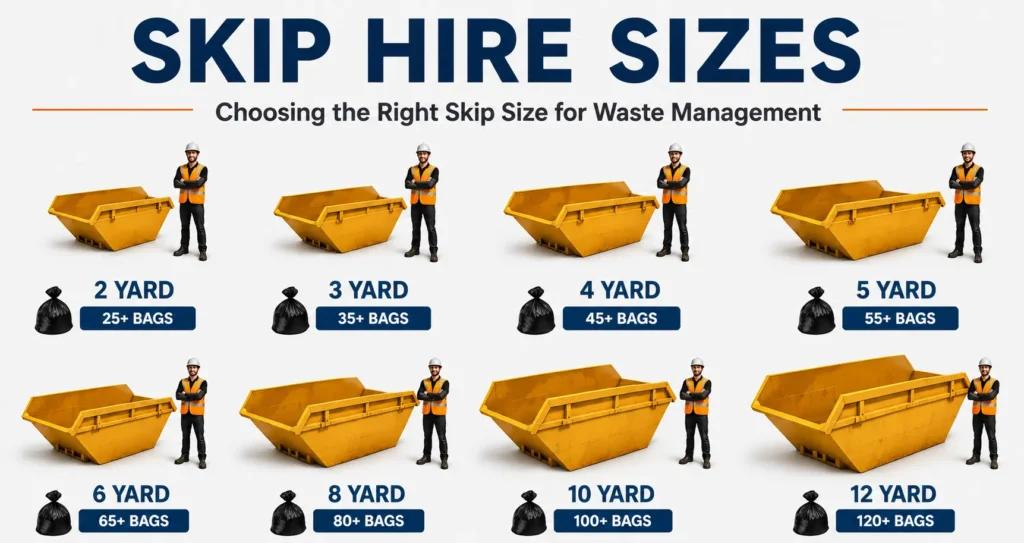
To make selection simple, we have broken down standard UK skip sizes, mapping their volume directly against standard black bin bags and practical project applications.
| Skip Size | Classification | Bag Capacity | Best Project Fit | Logistics Alert / Pro Tip |
| 2 Yard | Mini Skip | 20–30 Bags | Small garden cutbacks, minor bathroom floor replacements. | Perfect for heavy garden soil or pure brick rubble; leaves a tiny footprint. |
| 4 Yard | Midi Skip | 30–40 Bags | Complete bathroom refits, small kitchen clear-outs. | Can easily handle a mix of light fixtures and heavy floor tiles. |
| 6 Yard | Small Builders | 50–60 Bags | Medium kitchen renovations, bedroom stripping. | The maximum size recommended if your waste consists purely of dense soil or clay. |
| 8 Yard | Standard Builders | 60–80 Bags | Home extensions, entire house clearances, and roofing. | The Industry Workhorse. This is the maximum size most UK councils allow to be placed on a public highway. |
| 12 Yard | Maxi Skip | 100–120 Bags | Full property strip-outs, bulky shop fittings. | Light waste only. Do not load this size with soil or concrete; it will exceed legal road weight limits. |
Which Skip Size Works Best for Renovation Projects?
Matching your project scope to a specific skip requires evaluating structural material density:
Kitchen Renovations
Kitchen refits generate awkward, bulky, low-density waste: carcass units, laminate worktops, extensive cardboard packaging, and old appliances. Because these items don’t break down flat easily, spatial volume is your main concern. A 6-yard skip is the professional standard here to ensure you have the length required for worktop offcuts.
Bathroom Renovations
Bathrooms produce highly dense, heavy waste: porcelain suites, old cast-iron piping, heavy cement backing boards, and layers of ceramic tiles. While the volume looks low, the weight is immense. A 4-yard or 6-yard skip provides the perfect operational balance, giving you the physical space without risking structural overload.
Whole House Refurbishments & Extensions
If you are knocking down walls, excavating foundations, and replacing roofs, you are dealing with mixed structural waste. This requires a strategic approach. We highly recommend utilising an 8-yard builders’ skip for your heavy aggregates, and potentially pairing it with a separate container or a second exchange loop if high-volume timber and plasterboard are involved.
How to Estimate Waste Correctly: A Real-World Lesson
Let’s look at a scenario our Romford logistics desk handled recently. A local homeowner planning a kitchen and dining room knock-through calculated their waste based strictly on the volume of their old cabinets. They booked a 4-yard midi skip.
What they forgot to account for was the heavy building waste: the internal partition wall bricks, the lath and plaster, and the massive amount of protective wooden crating and structural cardboard that wrapped their brand-new appliances. Within 36 hours, the 4-yard skip was packed tight, yet half the old plasterboard was still sitting in the garden.
The client had to stop the builders, pay a wasted journey fee to swap the skip early, and order an additional 4-yard unit.
The Cost Breakdown: Two 4-yard skips cost roughly 35% more than ordering a single 8-yard builders’ skip right at the start.
Expert Operations Tips: Before You Book
Before you enter your payment details on any skip hire platform, verify these three operational criteria:
1. The Material restrictions Rule
Not everything can go into a standard skip. Licensed waste facilities face strict environmental regulations. Items like asbestos, plasterboard (when mixed with general waste), mattresses, fridges, car batteries, and old television monitors incur heavy sorting surcharges or are completely banned from standard mixed skips. Always declare these materials upfront.
2. The Public Highway Dilemma
If the skip cannot sit entirely on your private property (your driveway or private front garden) and must sit on a public road, you require a council permit.
- Many local councils take between 3 and 5 working days to approve these.
- You will also be legally required to place safety lighting and cones around the skip.
- A reputable provider will typically handle the council application on your behalf, but you must factor this timeline into your project kickoff.
3. Take a Photo Before You Call
If you are genuinely stuck staring at a pile of rubbish, wondering what size skip do I need, do not guess. Take two clear photos of the waste pile from different angles with an everyday object (like a wheelbarrow or a doorway) in the frame for scale. Send these over to our team; our dispatchers can instantly gauge the yardage required based on visual density.
Make Waste Removal Simpler, Not More Expensive
At the end of the day, picking a skip size isn’t a game of chance; it’s an operational decision that directly impacts your project’s timeline and budget. By understanding how material volume expands, keeping strict weight limitations in mind, and preparing for local council permit rules, you keep complete control over your waste management costs.
The next time you prepare to clear out a property or break ground on a build, look past the cheapest surface price. Factor in your true waste volume and potential hidden transport fees.
Working with established, transparent networks like Skip Hire Quotes gives you immediate access to localised logistics expertise, ensuring your waste is handled legally, sustainably, and completely within your budget.
Need the Right Skip Without the Guesswork?
Stop guessing dimensions and risking overfill penalties. Contact Skip Hire Quotes today to get direct access to local trade prices, real-time permit coordination, and expert scale guidance tailored exactly to your postcode.
Frequently Asked Questions
To complete a house clearing that includes furniture, old carpets and other junk an 8-yard builders’ skip is suggested. Massive items like wardrobes and sofas consume huge quantities quickly, even after being broken down.
Absolutely not. A 12-yard dumpster full of soil, concrete, muck or dirt is much too heavy for a normal 26-tonne skip loader to safely lift, resulting in dangers to hydraulics. Large maxi skips should be only for heavy-volume, light-weight materials like plastic, wood and cardboard.
Every local UK council has its own administrative costs and environmental regulations for obstructions to public highways. Costs vary based on the area, and certain areas also require active suspension of parking bays where the skip is within a parking zone that is permitted.